Social Intelligence @ UT-Vision

UT-Vision Lab · The University of Tokyo

Social IntelligenceAI that understands, generates, and takes part in human interaction

Everyday social life happens between several people at once. We infer what others know and intend, notice when something does not add up, and settle on plans together. This research line studies how multimodal AI can understand such interaction, generate it faithfully, and take part in it.

Click anyone at the table to jump to their project

Social Understanding

Understanding multi-party interaction: who is addressing whom, what each person knows, when a claim is a lie, and what behaviour actually reveals about someone.

CVPR 2026arXiv 2511.17952

Multi-speaker Attention Alignment for Multimodal Social Interaction
Liangyang Ouyang, Yifei Huang, Mingfang Zhang, Caixin Kang, Ryosuke Furuta, Yoichi Sato

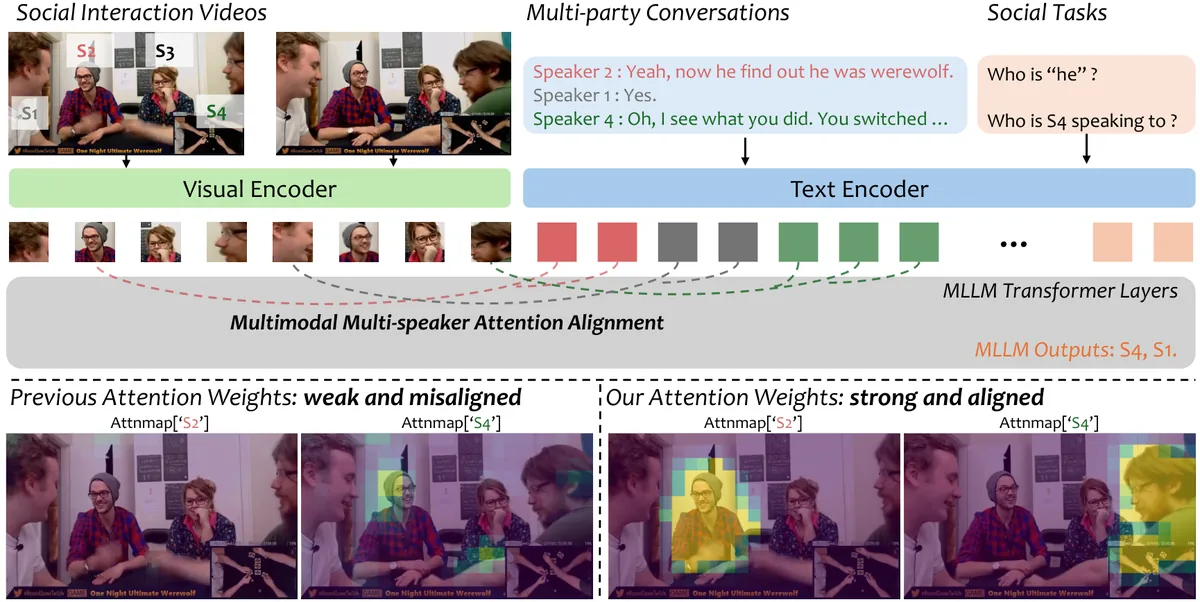
Overview of multi-speaker attention alignment, linking each speaker's visual tokens to their utterances inside an MLLM

Adding video to an MLLM gives surprisingly inconsistent gains on social tasks. We locate the attention heads responsible for cross-modal grounding and inject a social-aware attention bias derived from speaker locations, with no trainable parameters, in LLaVA-NeXT-Video, Qwen2.5-VL, and InternVL3.

The weak link is alignment. In multi-speaker scenes, a speaker’s visual tokens and their words barely attend to each other; restoring that alignment sets state of the art on four social tasks.
EMNLP 2026 MainarXiv 2511.16221

Can MLLMs Read the Room? A Multimodal Benchmark for Assessing Deception in Multi-Party Social Interactions

Caixin Kang, Yifei Huang, Liangyang Ouyang, Mingfang Zhang, Ruicong Liu, Yoichi Sato

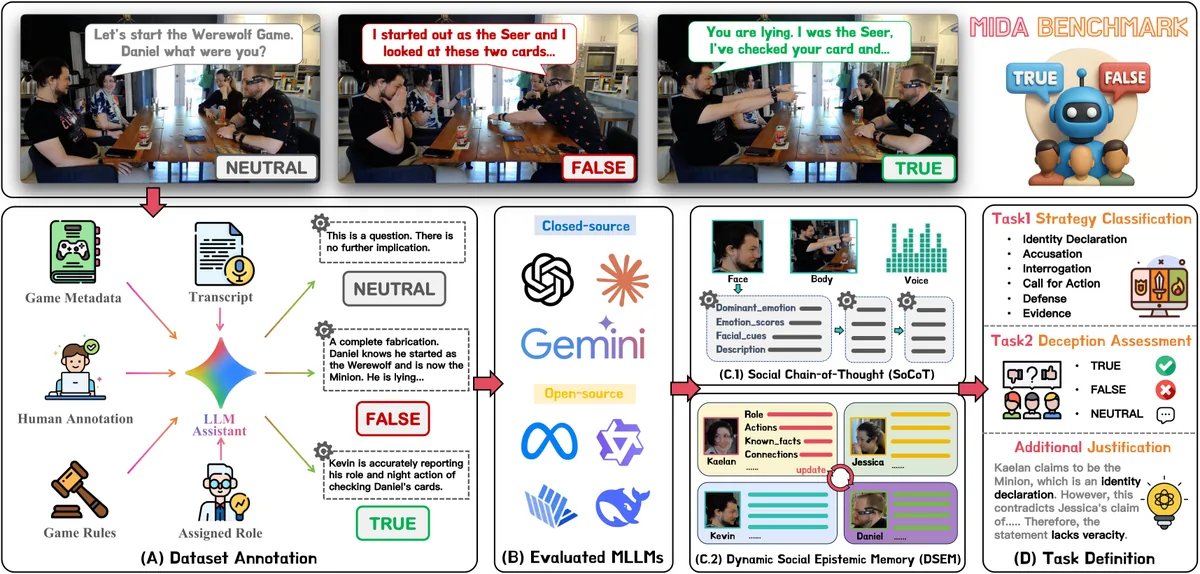
MIDA overview: Werewolf game clips labelled NEUTRAL, FALSE, and TRUE, the annotation pipeline, evaluated MLLMs, and the SoCoT and DSEM modules

MIDA asks whether each statement in a game of One Night Ultimate Werewolf is true, false, or neutral, with ground truth reconstructed from manually annotated night actions. We benchmark 12 MLLMs and introduce Social Chain-of-Thought reasoning with a Dynamic Social Epistemic Memory.

Even GPT-4o cannot reliably separate truth from deception. Models struggle to track what each player knows, and adding structured epistemic memory consistently helps.

Under reviewarXiv 2605.22109

Perception or Prejudice: Can MLLMs Go Beyond First Impressions of Personality?

Caixin Kang*, Tianyu Yan*, Sitong Gong*, Mingfang Zhang, Liangyang Ouyang, Ruicong Liu, Bo Zheng, Huchuan Lu, Kaipeng Zhang, Yoichi Sato, Yifei Huang

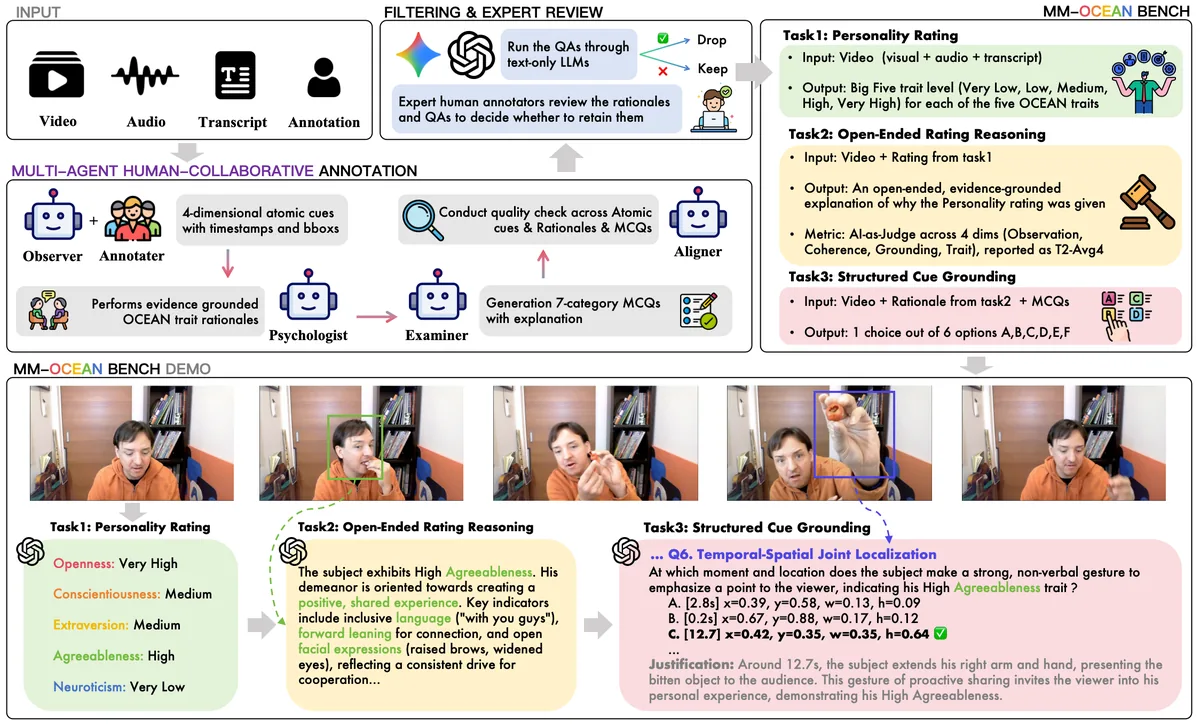
MM-OCEAN overview: grounded personality reasoning through rating, reasoning, and grounding

Grounded Personality Reasoning requires a model to support each Big Five rating with observable behaviour. MM-OCEAN provides 1,104 videos and 5,320 cue-grounding questions, and a three-tier evaluation of 27 MLLMs.

The Prejudice Gap. 51% of correct ratings are not grounded in retrieved behavioural cues, so models often reach the right score for the wrong reason.

arXiv soon

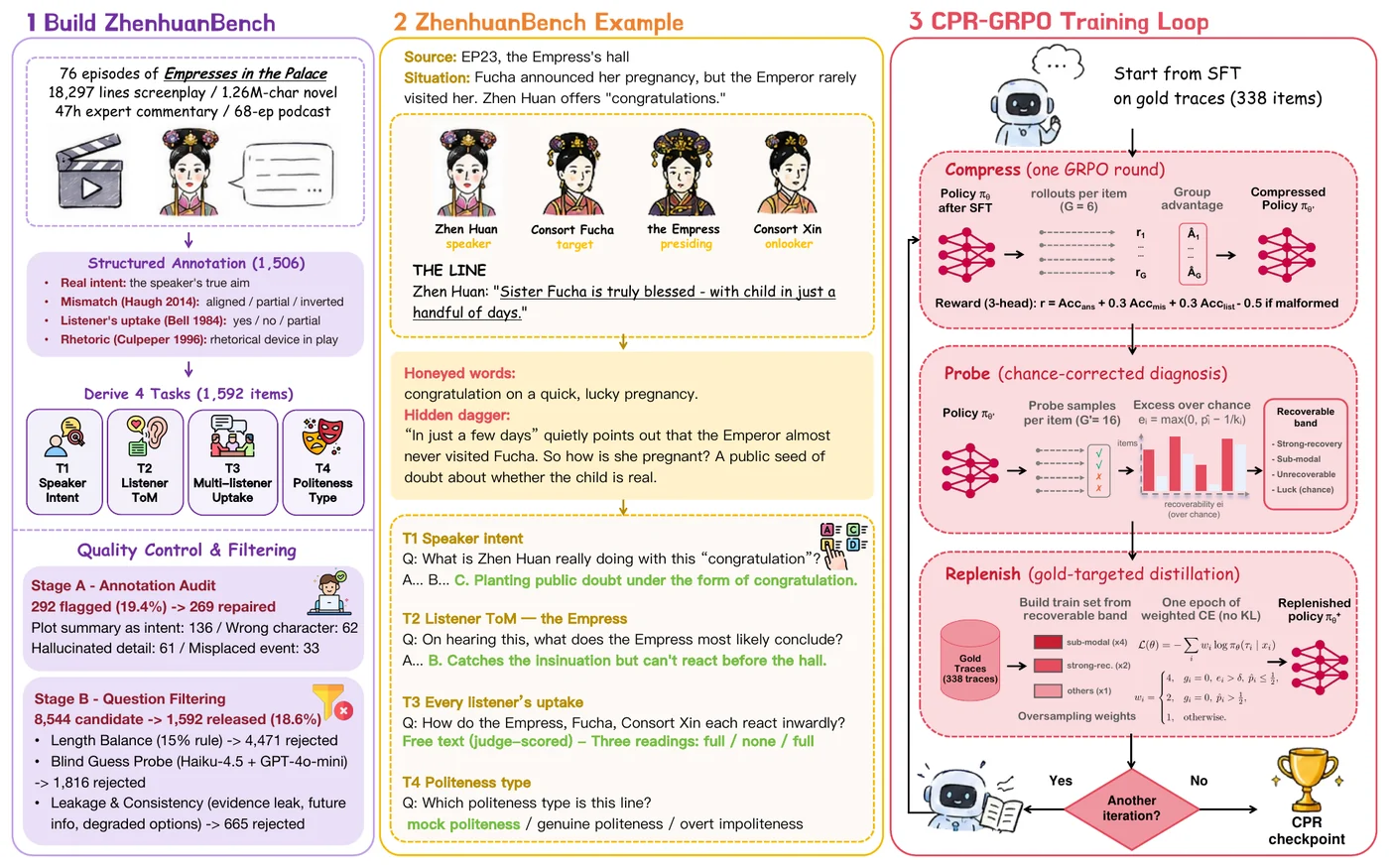
Honeyed Words, Hidden Daggers: Benchmarking and Training LLMs to See Through Mock Politeness

Overview of ZhenhuanBench and CPR-GRPO: building the benchmark from Empresses in the Palace, an example line with its honeyed words and hidden dagger, and the Compress, Probe, Replenish training loop

Mock politeness is polite in form but hostile in function. ZhenhuanBench turns 47 hours of expert commentary on Empresses in the Palace into 1,592 questions on speaker intent, emotion–language mismatch, and how each listener takes a remark. CPR-GRPO, a Compress–Probe–Replenish loop, reuses the same annotations to train an 8B model.

Reading the listeners is the hardest part. The best of 34 LLMs scores 73.48% overall but 58.37% on how listeners react; with only 338 gold traces, CPR-GRPO brings an 8B model to 67.0 on the multiple-choice tasks.

Social Generation

Generating video in which several people interact exactly as directed, and characters that respond when a viewer engages with them.

NeurIPS 2026arXiv 2605.10079

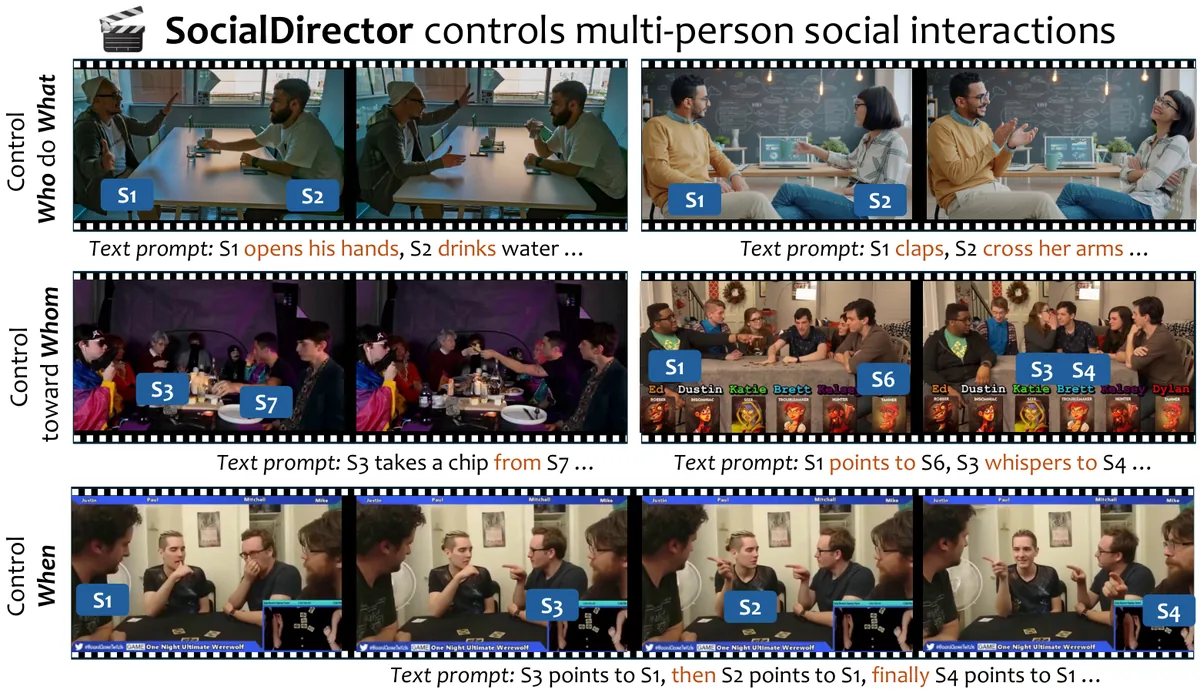
SocialDirector: Training-Free Social Interaction Control for Multi-Person Video Generation

Liangyang Ouyang, Ruicong Liu, Caixin Kang, Yifei Huang, Yoichi Sato

SocialDirector controls who does what, toward whom, and when in generated multi-person videos

Video generators often assign an action to the wrong person or direct it at the wrong target. Social Actor Masking binds each person to their own description, and Directional Reweighting steers each action toward its intended target, both by modulating cross-attention.

Close to real footage. Across different video generators, SocialDirector markedly improves interaction fidelity and approaches the upper bound set by real videos.

PreprintarXiv 2608.05070

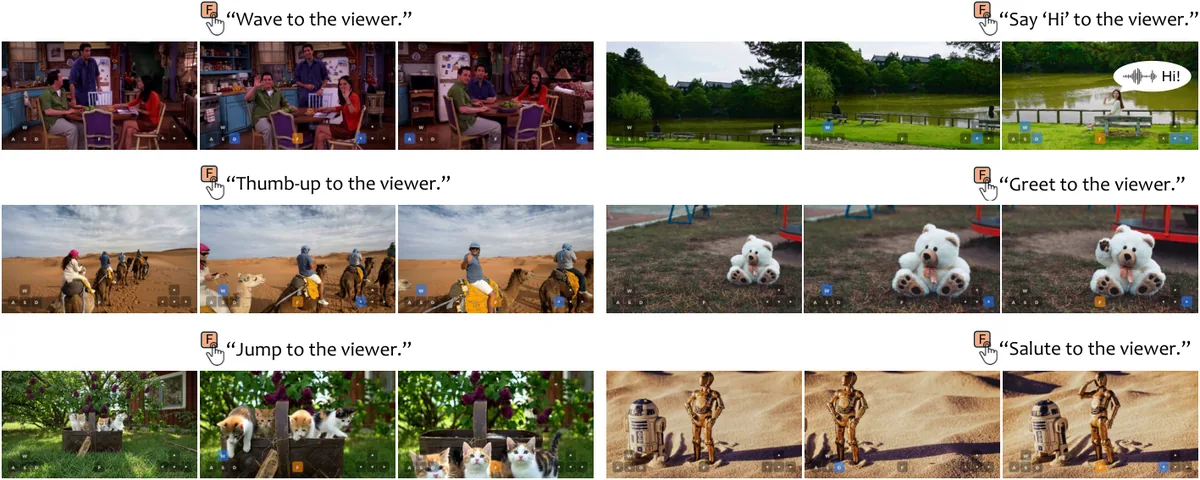
HelloWorld: Enabling Socially Interactive Characters in Video World Models

Liangyang Ouyang, Ruicong Liu, Xuangeng Chu, Kaipeng Zhang, Yoichi Sato

HelloWorld: pressing a button makes the on-screen character turn toward the viewer and greet them

A video world model whose characters respond to the viewer: at the press of a button, the on-screen character turns to the camera, waves, nods, or says hello. Self-distillation on clips the model generates itself adds camera control, and HelloWorldBench (400 samples) measures both social and visual quality.

Interaction without a trade-off. HelloWorld outperforms baselines on interaction quality while keeping state-of-the-art picture aesthetics and camera-pose following.

Social Agents

Agents that take part in conversations themselves, and reach outcomes that work for everyone involved.

PreprintarXiv 2610.20195

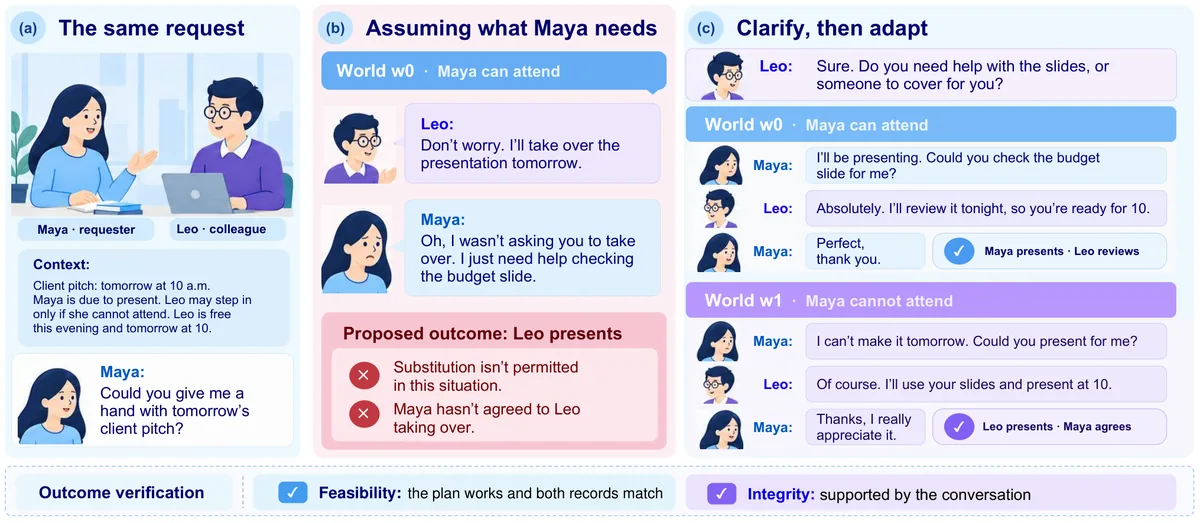
What Makes a Social Agent’s Interactions Effective? Learning from Verifiable Outcomes in Paired Worlds

Caixin Kang, Ke Wang, Yuchuan Wu, Xiaoqiang Wang, Ling Li, Bingxue Qiu, Yongbin Li, Yoichi Sato

HICO-Bench example: assuming what Maya needs fails, while clarifying first leads to a verified plan in both possible worlds

HICO-Bench pairs two agents holding private information across 180 everyday coordination scenarios and verifies whether the plan they agree on actually works. Paired-Credit Policy Optimization learns from these verified outcomes turn by turn, raising Qwen3-8B’s Verified Success from 20.4% to 28.3%.

Sounding helpful is not the same as helping. Across 13 LLMs, 36% of conversations rated highly for goal completion end in a plan that fails verification.

Pull up a chair

We’d love to hear from you. Whether you have a question about one of these projects, an idea for collaboration, or simply share our interest in social intelligence, please feel free to reach out to either of us.

Liangyang OuyangThe University of Tokyo Homepageoyly@iis.u-tokyo.ac.jp
Caixin KangThe University of Tokyo Homepagecxkang@iis.u-tokyo.ac.jp

Visitors around the world

Thank you for stopping by, wherever you are.

Visitor map by MapMyVisitors ↗